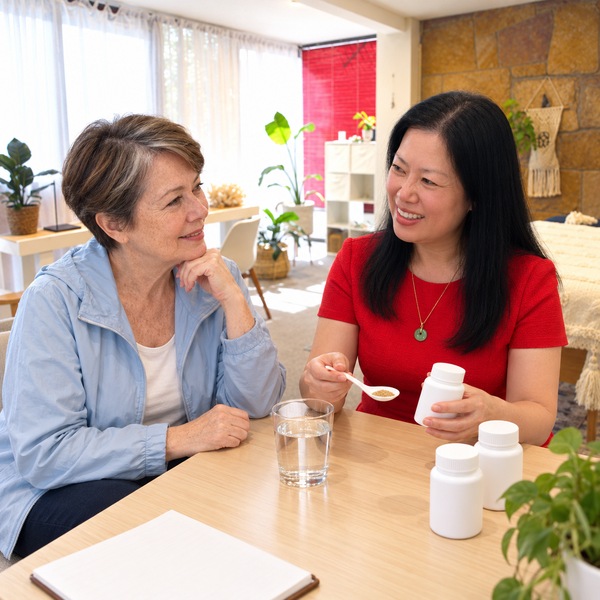
In traditional theory a formula is considered as a whole. Two granule bottles can look alike yet differ, so ask Christine what was selected for you and where its directions are.
Look at the label of a Chinese herbal formula and you may recognise a few names, perhaps ginger, liquorice or dates. It is tempting to judge the product ingredient by ingredient. In traditional Chinese medicine, though, a prescription is considered as a complete combination, chosen in relation to how a particular person presents at a particular time.
Dr Christine Shen, Acupuncturist, explains formulas in these terms, while being clear that this is traditional theory rather than proof that a formula suits every concern listed beside it.

Christine supplies herbal medicine as granules in bottles. Two granule products can share a name or look alike on the shelf and still differ in composition and in the directions that come with them. Swapping one bottle for another, or mixing products to copy an ingredient list found online, means you no longer know what you are taking.
A traditional explanation is a way of reasoning, not a promise of results.
Keep the exact product name, directions and review date together with the original container. Update Christine whenever your doctor alters another medicine. If something new appears and you cannot tell whether the formula is involved, call for advice instead of changing the dose by guesswork. Pregnancy, breastfeeding and planned surgery are also important to mention, since they can change what is suitable.
If you are curious about how a herbal prescription is put together, Christine is glad to explain the reasoning in everyday language. Herbal consultations take place at the Lane Cove clinic, and you are welcome to bring any bottles you already have so they can be considered too.
Copyright© 2002-%CURRENT_YEAR% visuallink© SaaS - Web Hosted Solutions, Design and Maintenance by Visual Link IT Pty Ltd - Software Solutions

Please Login or Sign up to be able to comment